Life Cycle Assessment: helical pile vs concrete foundation
Independent environmental lifecycle assessment comparing the carbon footprint of Paalupiste helical pile foundations against equivalent concrete foundations. Conducted according to ISO 14040/44:2006.
78% lower carbon footprint across the full lifecycle
This environmental life cycle assessment (LCA) quantifies the cradle-to-grave global warming potential (GWP100-Total, IPCC 2021) of the Paalupiste helical pile foundation, manufactured in Finland. The study compares it against an equivalent concrete and masonry block foundation designed for identical mechanical resistance.
The internationally accepted ISO 14040/44:2006 methodology and ISO 21930 lifecycle stages were applied, covering raw material production through end-of-life and recycling potential (modules A1 through D).
Primary data was sourced from verified Environmental Product Declarations (EPDs), supplier emission statements and the Ecoinvent 3.10 database. The study follows an attributional modelling approach with cut-off allocation.
Key finding: The Paalupiste helical pile foundation produced 89.3 kgCO₂e per foundation on a cradle-to-grave basis, compared to 407.9 kgCO₂e for the equivalent concrete foundation. This represents a 78% reduction in global warming potential.
Cradle-to-grave carbon footprint comparison
GWP100-Total results (kgCO₂e per foundation) across all lifecycle stages, from raw material extraction through end-of-life recycling potential.
| Lifecycle Stage | Description | Helical Pile | Concrete | Improvement |
|---|---|---|---|---|
| A1-A3 | Raw materials, transport & manufacturing | 169.3 | 347.1 | −51% |
| A4 | Transport to building site | 2.5 | 7.4 | −66% |
| A5 | Construction / installation | 4.8 | 38.3 | −87% |
| C1 | Deconstruction | 4.8 | 18.2 | −73% |
| C2 | Transport to end-of-life | 3.0 | 31.9 | −91% |
| C3 | Waste processing | 1.0 | 16.9 | −94% |
| C4 | Disposal | 0.2 | 1.7 | −91% |
| D | Recycling potential (credit) | −96.2 | −53.6 | −79% |
| A1-D | Cradle-to-grave total | 89.3 | 407.9 | −78% |
All values in kgCO₂e per foundation. GWP100-Total (IPCC 2021). Both foundations designed for equivalent mechanical resistance.
Why helical piles have a lower carbon footprint
Less material per foundation
A helical pile foundation requires significantly less raw material by weight than an equivalent concrete foundation. The structural steel pile, pile hat and gravel backfill total a fraction of the concrete, masonry, rebar, insulation, fill and drainage materials needed for a concrete foundation.
Higher circularity of steel
Steel is fully recyclable. At end of life, helical piles can be extracted and the steel recycled, generating a substantial recycling credit (module D: −96.2 kgCO₂e). This high circularity dramatically reduces the net lifecycle footprint compared to concrete, which has limited recycling value.
Faster, lighter installation
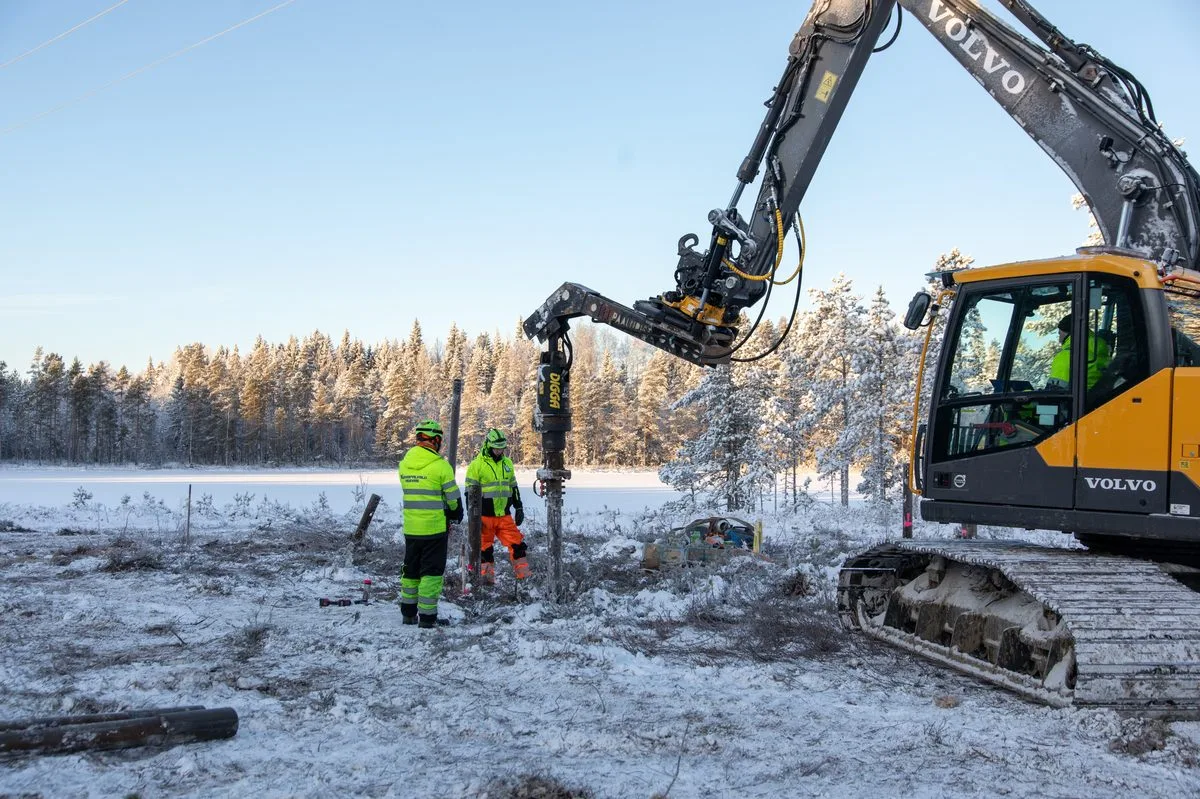
Helical pile installation requires only 15 minutes per pile with minimal excavation. Concrete foundations require extensive earthwork (2.5x more excavation), formwork, curing time and heavy machinery, all of which increase both the direct emissions and the transport footprint.
Steel dominates the helical pile footprint: Over 95% of the cradle-to-gate (A1-A3) impact of the Paalupiste helical pile comes from the structural steel tube and helical flange. Welding, packaging and other production inputs contribute less than 5% combined.
Study design and boundaries
The study was designed to compare two foundation solutions delivering equivalent mechanical performance, using internationally accepted lifecycle assessment standards.
Standard & Method
- ISO 14040/44:2006 lifecycle assessment
- ISO 21930 lifecycle stage nomenclature
- IPCC (2021) GWP100-Total calculation method
- Attributional modelling with cut-off allocation
- Software: openLCA 2.2.0
System Boundaries
- A1-A3: Raw materials, transport to factory, production
- A4-A5: Transport to site, construction / installation
- C1-C4: Deconstruction, transport, waste processing, disposal
- D: Reuse, recovery and recycling potential
Functional Unit
One complete foundation, designed to provide equivalent mechanical resistance. Both foundation types are described by detailed bills of materials provided by Paalupiste.
Design lifespan: 50 years for both solutions.
Data Sources
- Primary data collected by Paalupiste (2023)
- Verified Environmental Product Declarations (EPDs)
- Supplier emission statements
- Ecoinvent 3.10 secondary database (background processes)
Geographical coverage: Finland. All primary data represents existing Finnish production.
Material summary (by category)
Material quantities include 10% wastage allowance where applicable. Quantities are based on data provided by Paalupiste for foundations of equivalent mechanical resistance.
Limitations and intended use
About this study
This LCA was prepared as an internal study for Paalupiste to understand the carbon footprint of its helical pile foundation and benchmark it against an equivalent concrete foundation. The study was conducted by an independent researcher (Fernando Antonanzas, PhD) using primary data provided by Paalupiste.
No third-party critical review was performed. Results are relative expressions of potential environmental impacts based on the stated assumptions and data. They do not predict actual impacts, threshold exceedances, safety margins or risks.
Key assumptions
- Both foundations designed for equivalent mechanical loads
- 50-year design lifespan for both solutions
- 80% metal recycling rate at end of life
- 80% concrete recycling rate at end of life
- Finnish electricity grid for manufacturing
- 200 km downstream transport distance (helical pile)
Data quality
- Precision: High (primary + verified EPD data)
- Completeness: High (99%+ of mass flows covered)
- Temporal: 2023 production data
- Geographical: Finland-specific
- Technological: Current production methods
Disclaimer
This is a public summary of the full LCA report. Certain proprietary details (detailed supplier data, background database identifiers and reference annexes) have been excluded from this version. The full report is available under confidentiality agreement upon request.
Any deviation between the data provided by Paalupiste and actual production conditions would affect the results described. LCIA results are relative expressions and should not be used as the sole basis for comparative assertions without considering the full context, boundaries and assumptions of the study.
Background lifecycle inventory data was sourced from licensed databases. The LCA model file is available under NDA upon request for verification purposes.